
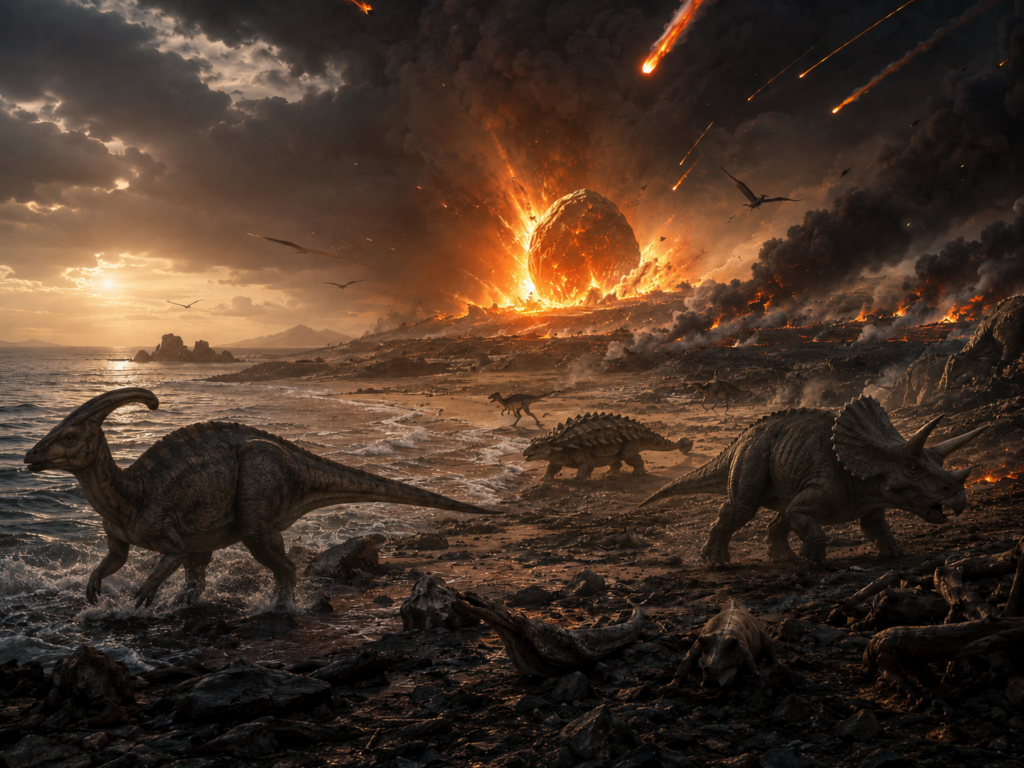
Dinosaurs have a way of making kids ask big questions. How big were they? What did they eat? Could they roar? But one of the biggest questions is also one of the most fascinating: What happened to them?
The short answer is that about 66 million years ago, a massive asteroid struck Earth near what is now Mexico’s Yucatán Peninsula. The impact helped trigger a global extinction event that wiped out all non-bird dinosaurs, along with many other forms of life on land and in the oceans. But like many great science stories, the full answer is more interesting than a single sentence. It is a story written in rocks, fossils, craters, minerals, and clues from all over the world.
A Clue Hidden in the Rocks
For a long time, scientists knew that dinosaurs disappeared from the fossil record around the same point in Earth’s history. What they did not know was why. Then, in 1980, physicist Luis Alvarez and geologist Walter Alvarez helped popularize a striking clue: a thin layer of clay found in rocks from that time period contained unusually high levels of iridium. Iridium is rare in Earth’s crust but more common in asteroids and meteorites, making it an important clue that something from space may have struck our planet.
That clue was later supported by more evidence. Scientists identified shocked quartz, tiny glassy particles formed by extreme heat, tsunami deposits, and eventually the Chicxulub crater, a huge impact crater buried near the Yucatán Peninsula. Together, these clues point strongly to an asteroid impact at the same time as the mass extinction.
What Happened After the Impact?
The asteroid itself was enormous, likely around 10 to 15 kilometers wide. When it hit Earth, the energy released was devastating. Near the impact site, there would have been intense heat, shock waves, earthquakes, fires, and massive waves. But the bigger danger may have come afterward.
The impact blasted dust, soot, and other material into the atmosphere. That debris reduced the amount of sunlight reaching Earth’s surface, which would have disrupted plant growth. When plants struggled, plant-eating animals struggled too. When herbivores declined, predators had less food. The result was a chain reaction through entire ecosystems.
This did not only affect dinosaurs. The end-Cretaceous extinction was a global event. Many marine organisms, ammonites, pterosaurs, and large marine reptiles also disappeared. Scientists estimate that around 75% of Earth’s animal species died out during this extinction event.
Was It Only the Asteroid?
The asteroid is the leading explanation for the extinction of non-bird dinosaurs, but scientists also study what else was happening on Earth at the time. One major factor was intense volcanic activity in what is now India, known as the Deccan Traps. These eruptions released gases into the atmosphere and may have affected global climate before and after the impact.
Some researchers have explored whether volcanism alone could have caused the extinction. A 2020 study in Proceedings of the National Academy of Sciences tested asteroid and volcanic scenarios and concluded that the asteroid impact was the main driver of the non-avian dinosaur extinction, while volcanic activity likely added environmental stress and complexity to the story.
That is an important lesson in how science works. Scientists rarely stop at the first answer. They keep testing evidence, comparing explanations, and asking better questions.
Did Any Dinosaurs Survive?
Here is the surprising part: dinosaurs did not disappear completely. Birds are living dinosaurs. More specifically, they are the only dinosaur lineage that survived the mass extinction. So, while Triceratops, T. rex, and other non-bird dinosaurs vanished, the dinosaur family tree continued through birds.
Other animals survived too, including some mammals, reptiles, amphibians, fish, insects, and plants. Many survivors were small, adaptable, or able to live on food sources that remained available after the impact. Over time, life recovered and changed. Mammals eventually diversified, flowering plants continued to spread, and the world slowly became the one we know today.
What Are Scientists Still Learning?
Even with strong evidence for the asteroid impact, scientists are still learning more about the details. How long did the darkness and cooling last? Why did some species survive while others disappeared? Were dinosaurs already declining in some parts of the world, or were many still thriving right up until the impact?
New research continues to add pieces to the puzzle. In 2024, scientists studying chemical signatures in ancient rocks reported that the Chicxulub impactor was likely a carbonaceous-type asteroid that formed beyond Jupiter, offering new insight into where the object may have come from.
For kids, the mystery of dinosaur extinction is more than a prehistoric question. It is an invitation to think like a scientist: look for clues, compare evidence, stay curious, and remember that even the biggest mysteries can be explored one discovery at a time.